Asake's Spirituality: When Creativity Expresses The Mystical
Art is a true religion. That a genuine devotee: a passionate artist, journeys into his soul to seek the most loving emanation of himself through an extremely intentional and meticulous process of conveying his innermost thoughts and nuances with the purest empathy and compassion he can muster, just to resonate the feeling he wants his fellow man to experience

A short treatise on Art
Art has always been an abstract medium for man to project the innate motions and flux of the mind in the most expressive way feasible. A quote I once came up with, back in the day when I was coming to terms with the real significance of art, was that “Art is the poetry of the soul.” Yes, art is the poetry of the soul. This definition upholds the metaphorical depth that eludes literal-ism, or, safe to say, “peripheral translation.” This definition holds true in the vein that poetry, in simple terms, is when we use words to provoke emotions and imaginary visuals in the mind of an audience. When we are trying to say things without directly saying them how they are — or, at best, due to a lack of suitable convenience for conveying the meaning we strive to convey — that is poetry
Art is a medium of resonance, an invitation for the protagonist himself to engage his power of critical reasoning to deduce a meaning for himself from the piece he is currently beholding. This brings forth another quote that came to me at one point in my evolutionary journey of service: “Art is the only true form of evangelism, for it preaches without judgment and inspires without coercion.” Taking this further with a definition that is cognizant of our individual wholeness and independent units of God, I think it would be safe to say that “Art is the language of God.”
It seems that Asake configures his mentality and attitude to fit the abstract nuance of his songs, finetuning his voicing and breath control to blend with the mood of the beat in perfect synchronicity, whence conveying the five-dimensional meaning of his songs
If art is the language of God, how do we define music? Of course, music is an expression of art through sound, comprising frequencies, harmonics, overtones, interval relationships, etc. I guess we are getting somewhere. Okay, right: music is an art form, but how do we find a direct literal translation for it within the scope of the definition of art as the language of God? Let’s see. Art is the language of God; music is an “art” form. That means music is an application of art — the language of God — since music comprises sound. From this, we can deduce that music is the art of sound, right? We are almost there: art is the language of God, and music is the art of sound. Yes, words are made up of sounds, so the harmony of sounds comprising music in artistic application suffices to say that “music is the communication of God.”
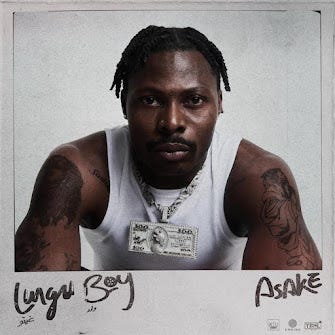
Maybe that was quite a lot to take in for you. Pardon me; I delve into depths like this when I am trying to rationalize concepts for a more clarified comprehension — or better still, for the sake of my sanity! Haha… Of course, it’s time for us to delve into the essence of this piece: Asake. This piece gets its title from the inspiration I drew after absorbing the numerous nuances from Asake’s most recent album: Lungu Boy. Oh boy! It was a bold statement and a “shut-up” moment for critics. But we’ll get into all that later in the piece. For now, let’s journey through his creative evolution by chronologically analyzing his discography. For those who have ears to hear, Asake’s evolution has been a beautiful sonic journey of multiple artistic expressions — a sustenance that doesn’t seem to be half-depleted yet, at least for the moment. So, who is Asake? How did he come into the limelight? What defines his musical essence?
Profile
His contemporaries at the University of Ile Ife attest to him being a one-of-a-kind stage performer. One of these is Blackbonez, a superstar in his own right. He and Asake are part of the same alumni at the University of Ife. Asake’s stagecraft is no surprise, given that he studied drama and theater arts. A notable attribute that cannot be taken away from him is his alchemy: Asake was not always a musician; he has been a dancer, show host, and stage performer. His final choice of music as a career mainstay makes it clear that he found himself in the most fluid avenue of artistic expression. Every genuine creative must tread this path; it is one of truth and mastery, and at the end of it lies the dividends of self-actualization.
Asake came into the limelight by leveraging his immense talent with the already established platform created by YBNL CEO Olamide. His rise to fame was characterized by continuous back-to-back hits, which the mainstream music industry couldn’t help but acknowledge by granting him his deserved space. Asake’s style revolves around complex rhythm cadences that ride on the wave of sonorous, soothing melodies vocalized with a thoroughbred West African indigenous accent; he stands out effortlessly.
Asake is him, and he knows it, but there is something about him — something about his artistry — that evokes an awareness of the mystical. It is a playground for the curious mind to explore the dimensions of the abstract. It’s about how Asake blends his vocals, ad-libs, hums, and chants so seamlessly that their pulsing perfectly correlates with the emotional nuance of the overall music itself. It’s nothing other than exceptionally genuine artistic mastery. Let’s make an attempt to deconstruct — walk with me.
His lyrics tell you something; his rhythm expresses the motion of the context; his voice texture conveys the emotional temperament; and the instrumentals create the virtual reality of the song’s message
Discography
Asake’s first hit song, “Omo Ope” was more than just a conventional hit; it ushered in an era of using high-pitched reverb choral backups that emphasized ad-libs and choruses — a trend that has become a tradition in the Nigerian music industry. You may have heard this effect in one or more contemporary Afrobeat songs. This is a certified part of Asake’s legacy and is worth immortalizing him for. His follow-up tracks solidified the niche he had already created: fast-paced, complicated rhythm patterns and melodies.
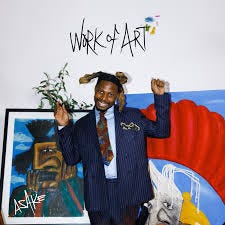
His sophomore album, Work of Art, built on the foundation of this niche. It emphasized the choral effect further, incorporated deliberate vocal temperaments, and took listeners on an emotional journey of empathy with careful curation of chord progressions and unique percussive soundfonts and patterns. Each of his antecedents shows a dedicated creative who took the time to meticulously find his sound and define a one-of-a-kind sonic brand. This brand has imprinted an eccentric image in the minds of his fans.
He has capitalized greatly on this self-crafted leverage and has milked it considerably for a while. However, as with every creative manifestation, it eventually fizzles out in appeal over time, leading to the widespread notion that his craft was too monotonous and lacked dexterity. This is where it gets really interesting. His most recent work, the Lungu Boy album, did more than enough to dispel the accumulated doubts and skepticism regarding his craft. This is the essence of this article: to perceive Asake’s greatness from a devotion that transcends the normal and approaches a mystical translation. Yes, Asake’s spirituality is evident, for only a soul refined to such a height of alchemy can manifest the degree of dexterity evident in the Lungu Boy album.
When he conceives his sounds, motions, rhythms, breath, and ad-libs, he is performing an act of worship. And when he compounds all that he has received into an artistic masterpiece, he is fulfilling his purpose of evangelism
Mystique

Yes, this project took us around the world, but did you pay attention to the stylish vocal pitching per song’s temperament? Notice how he intentionally exudes pain and remorse on “MMS,” where he features Wizkid, even though the song is supposedly meant to celebrate his wins. Observe the psycho-visual correlation between his cadence, vocal texture, and the tonal color of the instrumental on the song “Mood,” among many other examples of artistic resonance throughout the album. It seems that Asake configures his mentality and attitude to fit the abstract nuance of his songs, fine-tuning his voicing and breath control to blend with the mood of the beat in perfect synchronicity, conveying the five-dimensional meaning of his songs. His lyrics tell you something; his rhythm expresses the motion of the context; his voice texture conveys the emotional temperament; and the instrumentals create the virtual reality of the song’s message. Asake shows you something in the physical and then uses the spiritual to project you into a virtual reality where you actively participate in the reality he presented. What mastery! He has perfected the art of having his listeners see, feel, and live in the colors, emotions, and desired reality he envisions.
Asake, for a fact, is feeding on something — be it an energy field, a memory, a psychosis, or the ecstasy of a self-alchemized mental nirvana. He is certainly drawing from a source, and that source’s energy supply doesn’t seem to be waning soon. Religion preaches belief in a deity or supreme monotheistic being; Asake appears to dwell in a place of utmost obedience and dedication to the agency that stimulates his understanding of the vast array of artistic and beautiful elements that resonate with his innate desire to share his paradise with his audience. When he conceives his sounds, motions, rhythms, breath, and ad-libs, he is performing an act of worship. And when he compounds all that he has received into an artistic masterpiece, he is fulfilling his purpose of evangelism. This is Asake’s spirituality — the seamless flow of his ikigai.
This also serves as a reminder that art is a true religion. A genuine devotee, a passionate artist, journeys into his soul to seek the most loving emanation of himself through an extremely intentional and meticulous process of conveying his innermost thoughts and nuances with the purest empathy and compassion he can muster, just to resonate the feeling he wants his fellow man to experience. Pure service.



Comments
Post a Comment